

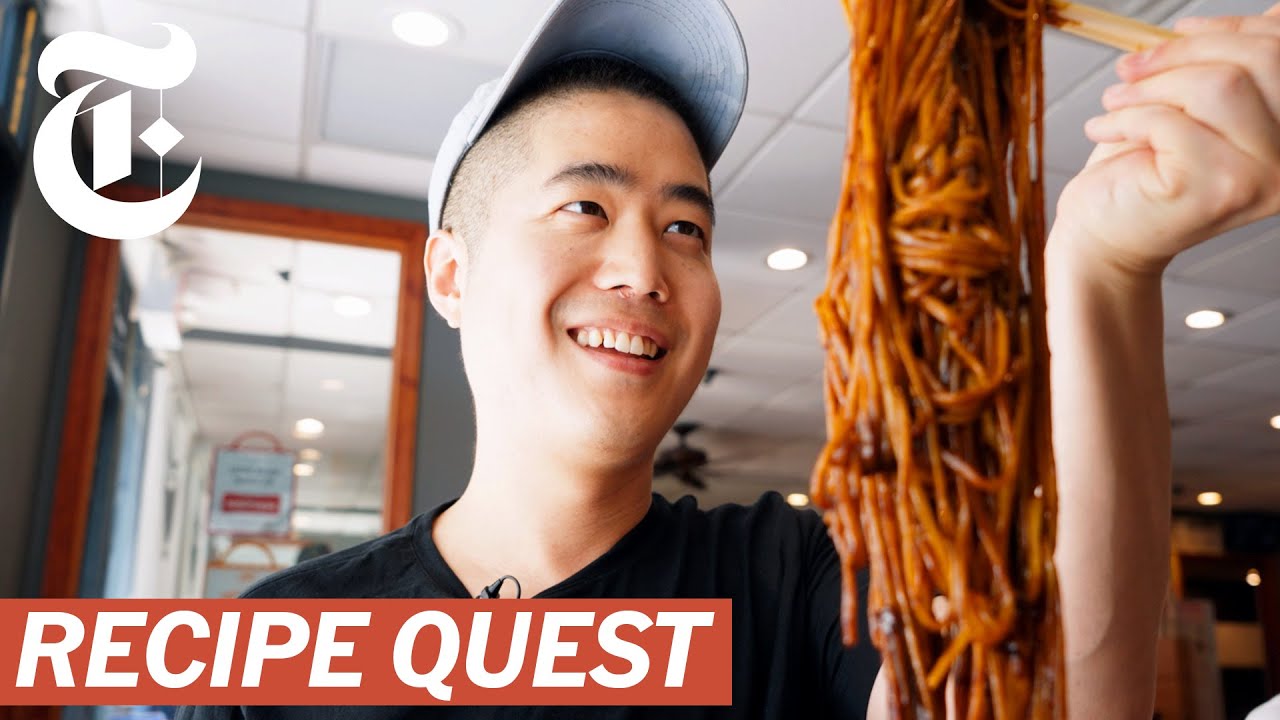
“So we’re in Queens. We’re at Korean Noodle
House for our first –” [THEME MUSIC] “Today’s episode
is really exciting. It is jjajangmyeon. Jjajang is black bean paste. Myeon means noodles. It’s a rich dish, truly
like deep fried, usually. It’s a mixture of so many
different experiences And cultures. And I think I would describe
it as Korea’s take on Chinese Takeout. It’s not an everyday food. It’s celebration food. It’s Friday food. This is a video about
finding New York City’s best Jjajangmyeon. I don’t really have a
go-to jjajangmyeon here. The fact that I can
spend two full days just Traveling around New York
City and eating jjajangmyeon Is a real dream. Our first stop of the day
is Korean Noodle House. So let’s — let’s go.” [MUSIC PLAYING] “It’s time. It’s time for jjajangmyeon. O.K., so usually, the
meal comes with a side Of vinegar and soy sauce. I take it and I pour
it over the onion. Sort of softens its heat. This came out pretty quickly. I think of the sauce less as
a sauce and more as a gravy. It’s like a big gravy
over the noodles. Anyway, I’m really
excited to have this.
And the effort is
to try to mix it.” [MUSIC PLAYING] “Look at that. Mm. Even a bad bowl of
jjajangmyeon is really good. This one’s very good. It’s hard for this to not
be just absolutely soul Satisfying. Mm. I really like the
balance of flavors here. It’s not too salty,
not too sweet. I’m looking forward to tasting
many more across the different Chinese, Korean restaurants
in New York City, So that my tongue can
decide what flavors I want To prioritize in my
version of this recipe. So this next place is
where everyone in my circle Told me to go. A lot of people said [KOREAN]. I’m excited. Let’s go to the
next one right now.” [MUSIC PLAYING] “What’s really special about
this one is it has fried Potato in it. If you are frying the
vegetables anyway, You might as well
throw in a potato. This is more savory than
the last place, for sure. Fewer onions, actually. So it’s interesting. This one has greater variety
of vegetables filling it up. And the last place
was all onion, Which is more often
how I’ve had it. So I love the idea of
adding as many vegetables As you want. This dish is making
me think about how
I want the meat to taste. The last place was super
crispy, which is interesting. The meat is less present. It’s more about the
vegetables on this one. That’s cool. I learned a lot
with this bowl. I’m really full, but we’re
going to walk it off and then Go to Manhattan.” [MUSIC PLAYING] “So we are on 32nd Street,
which is arguably the busiest Street in New York City,
in my opinion, Koreatown. And this is Shanghai Mong. This is a restaurant that
I’ve been coming to for maybe A decade. And I’m going to
meet my friend Maddy, Who’s a food content creator
and recipe developer. I’m excited for her to
taste this jjajangmyeon. Hi. How are you?” “Hello.” “Good to see you. Thanks for coming. — been here since NYU days.” “Really? O.K. All right.” “I’m excited to try this.” “I told you I didn’t eat
lunch today to eat this.” “Right. [LAUGHS]:” “It’s really good.” “Mm. Wow, that’s excellent. My earliest memories
of jjajangmyeon Are from Buford
Highway in Atlanta.
What about you? Do you know — What’s your jjajangmyeon
experience growing up in Korea And then coming to America?” “So my earliest memory with
jjajangmyeon is being a really Small kid, like six,
seven years old, And then being scolded for
having it all over me while I Was eating.” “Oh, really?” “Yeah.” “Oh.” “It was all over my dress.” “Aww.” “But I think it’s been
always part of the Korean –” “– experience.” “Yeah, Korean
experience, really. Every time there
was a milestone, There was always
jjajangmyeon, I think. And growing up in Korea,
it was like moving food. So whenever you moved, and
you couldn’t cook in your own Kitchen, you’d always get
jjajangmyeon delivered To you.” “Yeah. Did you live in Korea when you
would have to return the bowl Outside?” “Yeah.” “Is that what –” “Yeah, yeah, yeah. I think the tail end of it. So there was –” “Yeah. Because they don’t do
that anymore, right?” “No, no, no. They would deliver it
in these metal boxes.
In the apartment complexes,
when you walk around, There would be empty bowls
in front of the houses where They’ll come and pick it up.” “This is definitely the
chewiest we’ve had so far. Also –” “There’s such a difference
between fresh noodles –” “The not-fresh noodles
are quite disappointing.” “They’re too soft.” “They’re too soft.” “It has to have that
elastic bounce to it.” “Elastic. Thank you for joining me. This was really fun.” “Of course.” “Cheers.” “This was really delicious.” “We’re going to
finish our meal. Day one complete. Whew!” [MUSIC PLAYING] “We’re at [KOREAN]
in Manhattan. And we’re picking up
where we left off. It’s been a few days. I’ve been digesting. And now I’m looking forward to
eating more jjajangmyeon all Day. And we have
Christine joining us. Christine is my colleague
at the New York Times. She’s on the travel desk. So have you been here?” “I don’t think I’ve ever
been here, actually. I’ve been to the one on
32 that’s pretty popular.” “Yeah, yeah, yeah.” “But for me, jjajangmyeon is
the thing my parents order
In Queens and bring
back the sauce, And we eat it in Connecticut,
which is where I’m from. So it’s more of like a
nostalgia thing I eat at home With my family.” “Interesting.” “Is it good?” “Mm-hmm. Wow, super creamy. Super — not in a bad way, but
emulsified with a lot of oil.” “[LAUGHS]: And the noodles are
extremely al dente in a way That is really delightful. A pretty messy food. Not a food to order
on a first date. Date like 10.” “Mm-hmm. We’re on like friend date 10.” “Mm. [LAUGHS]:” “I thought the flavors
in this were lovely. It was almost a creamy sauce
in feeling, not in flavor. And it wasn’t like a
gloopy, cornstarch-y thing. Wow, that was delicious. We’re going to digest and
then head over to Jersey For the next couple of bowls. Wow, Jersey is known
for Korean food. Jersey is Korean food town.” “The epicenter –” “The epicenter.” “– of Korean food.” [MUSIC PLAYING] – [SPEAKING KOREAN] “And house-made noodles. Hey, this looks good. This is the least sweet
jjajangmyeon we’ve ever had.
That’s a beautiful sauce. That is — that’s what
dreams are made of. Look at that. Yeah, the flavor, though, it’s
sort of like a cleaner flavor Than the others. Feels like it comes
from the vegetables. Whoa. This is the kind
of jjajangmyeon I would come to
eat once a week. It feels homemade,
in a good way. You have to come to
Jersey for jjajangmyeon. Ugh, no more words. I’m just going
to eat, I think.” [MUSIC PLAYING] “I love that everyone
does it so differently. That’s really the thing about
this whole Recipe Quest. Honestly, when we were
talking about this episode, We were kind of worried
that they would all Bleed into each other
and taste the same, But they all just
look so different. O.K., we got the house, kind
of regular jjajangmyeon. And it has kabocha
squash in the gravy. O.K., I’m going to go for it. There’s a piece of squash. That’s lovely. And the meat is
ground, actually. That’s cool. That’s different. Jjajangmyeon is really
like 50 percent onion. Onion is a really
primary ingredient. And I think it’s
really fun that — It’s so Korean to serve
the raw version of it, Not just the raw onion,
but also the raw chunjang, The black bean paste that
the sauce is made out of.
As a kid, that was
always on the table. And I was always like,
why is that there? It’s like that gross
thing that adults eat. But now, as an adult, I’m
kind of like, this dish, It’s so delicious,
but it’s so rich. You kind of need
something to cut through. One thing that you do as a
Korean person is you take This, and then you — My dad — my mom and dad are
always at the end of the meal Doing this, covering
their mouth with one hand, You know — Anyway, thanks for joining. I’m going to get
back to my food. See you in a bit. So it’s been two
days of jjajangmyeon. I learned so much about
how to differentiate Your bowl of jjajangmyeon. Definitely not doing
homemade noodles. I don’t have the
patience for that. I need to perfect the
technique that’s going to help A home cook buy incredible
fresh noodles in the market And show them how to
cook them the best way. I’m going to focus
more on the gravy, But I’m going to keep it
simple and just try to come up With a version that pulls from
all of these that I’ve had And that celebrate New
York jjajangmyeon.” [MUSIC PLAYING] “One thing I learned in my
field research was that a lot Of these jjajangmyeon
sauces rely on the broth, The broth that then becomes
a gravy once starch is added. So I thought that chicken
broth would be a nice Replacement for the water,
especially when you’re not A restaurant that has to make
gallons and gallons of this Sauce.
I noticed a lot of
jjajangmyeon recipes Call for sugar. Though sugar is
great in a pinch, I figured, what
about maple syrup? I like the darker, more
complex, aromatic sweetness It adds. And so I tried it, and
it worked really well. The final touch of
this jjajangmyeon Is julienned cucumber. I wasn’t completely sure
whether or not I wanted My version to have it. It’s that
quintessential taste, Which is a really
classic addition. And you need a little bit
of that aromatic cucumber Right on top. Let’s cook my
ultimate jjajangmyeon. Start with pork belly. We want the pork belly without
the skin for this recipe. So now we’ve got
this nice pork belly. I’m just going to cut it
into pieces first, about, I don’t know,
half-inch-thick pieces. Try to grab some fat
from the other one. As the pot is coming
up to temperature, I’m going to add the
fat to render slowly. I’m going to add the pork. And just fry away
for like 10 minutes. You want it to get
nice and crispy. This is actually
your opportunity To season the pork. I was trying to replicate
the high-heat bulmat, Like fire taste of
jjajangmyeon, which is usually Created in a wok. So you can use a wok. But I developed this
with a Dutch oven.
So you just really need a
nice, heavy-bottomed pot So that you can truly
develop that fond. And I’m really
happy about this. It’s rendering fat. There’s not a huge pool of it. What it’s really going to
do is fry the vegetables And then, in the end, just
emulsify with everything And be delicious. So jjajangmyeon, it’s really
about the flavors of the very Humble ingredients that
these restaurants were using. And one of them is onion. But another one that I
really like is cabbage. So what I like about this
recipe is there’s no removing Meat from pots. There’s no —
none of that crap. You just add all of
it consecutively. I would say this
is kind of medium. So I’m going to go for a third
or a quarter and see where I’m At. Same shape. I’m just going to leave it. This gets cooked down. Those vegetables are going
to be melty and really lovely In the final gravy. Yes, yes. Do you see this? It’s sticking. When your vegetables start
sticking to the bottom Of the pot, that’s your
signal to add the chunjang. Chunjang is the
fermented black bean Paste that forms the
foundation of jjajangmyeon. What’s really confusing
is it’s not often labeled As chunjang. It’s labeled as jjajang,
which always confused me,
Because jjajang is the
sauce that we’re making. I think of the chunjang
as tomato paste, And then the jjajang is
kind of like the Bolognese. I personally don’t think you
should use the kind that says Bokkeum jjajang. This has been
doctored a little bit. I think it would
work in a pinch. But if you can, try to
find one that just says Simply jjajang or chunjang. This one says black
bean paste fermented. I like this one. But they also come in
these cute little boxes. So these are cool. This is the one I
brought from home. And it’s already open, so
I’m going to use this one. One, just straight in. Really beautiful. And I like to use
a half, 2 and 1/2. Mm, delicious. It’s so cool, the way it
glosses the vegetables And pork. Look at that. You see how shiny it got? The chunjang is
starting to interact With the vegetables and meat. And frankly, this would
be so delicious by itself. It’s like a stir
fry right now. But you see where the black
bean paste is separated from The oil, kind of like they
don’t want to be together? But what we’re going to do is
simmer this pot for about 20 Minutes. Not only does that get the
pork luxuriously tender, The broth is also going
to gain so much flavor From all that amazing
stuff in the pot, right?
Jjajangmyeon has sugar. It just does. And it’s the balance
of salty sweet. I tried sugar. It was fine. I love maple syrup. I think it’s the best
sweetener in the world. 2 tablespoons of maple
syrup really go a long way. I love maple syrup. O.K., so this just
comes to a boil. I’m going to lower the heat
and then simmer this for 20 Minutes. See you later. It’s been simmering
for 20 minutes. It’s not 100 percent done yet. What we’re going to do now
is raise the heat to high. But also, we’re going to
add some starch in the form Of a potato. I’m going to grate
this raw potato. I only need a
little bit of it. I want a fine grate
on the potato. I love this step
because it gives you The thickness you want, but
not the cornstarch-y kind Of gloopiness, which,
for some people, Is the taste of nostalgia. But I grew up with potato
thickening the sauce. And you do want to grate it. I’ve done this before where I
just food processed a potato. And I just didn’t love it. So I’m just stirring that
in, raising the heat to high. As this finishes cooking,
we’re going to let it really Vociferously boil. The potato will cook. It’ll swell.
It’ll thicken the gravy. The little beads of
oil and fat on top Will emulsify with the water. And then we’ll have
that beautiful sauce. The reason you want to fine
grate is bigger slivers Of potato will make
it cloudy, so — Yum, yum, yum, yum. So good. Frankly, if I were
cooking for my mom, I would leave it there. But I think I want
a little more — A little more salt. This is where you really
just use your eye. The longer it simmers,
the thicker it’ll get, Because again, you do want to
cook the pork a little more. You want the pork to
be melt in your mouth. I love these noodles. They really work. It says fresh jjajang noodles. It’s your opportunity to go
to the refrigerated section And get fresh noodles. It will change your life. They are delicious. They are so different. I love them. So I’m taking out my phone
because I want to time this Exactly right. Follow the directions
on the package. It says, boil for 5 minutes. I’m going to take them out at
4 because I like to leave room For a little human error. One of the bundles is
obviously a serving. And boil it for
about 4 minutes. Of course, I missed
the pot completely.
really get in there. You’re rinsing off the starch. You know what I mean? Just really — until
it’s no longer slippery. O.K. So that’s my
portion of noodles. This is going to go quick. One dunk. That’s it. And so it doesn’t have as
much starch on it as before we Rinsed it. But now they’re hot again. Look at those. Noodle people say
this all the time. Noodles die. Like, you need to eat this
right now, or quickly. Now the gravy. Oh, baby. It’s thick. It’s glossy. Beautiful. So just get a huge
spoonful of it. Some people style it where
it’s only covering one side. But when I had it at
all the restaurants, They just poured it on. Sometimes there’s
fresh cucumber on top. And now we just go in. See how well it mixes? Oh my god, I haven’t
eaten anything today. [SLURPS]: Mm. Mm.
Mm. It really hits the
spot, you know? I just like — I love these noodles. It makes me think
about how far I’ve come In my jjajangmyeon journey,
how much I’ve learned from Other people. And they’ve helped me arrive
at the version that I really Enjoy. The building of
flavor, it happens From very humble ingredients. And I think that’s why
this bowl is so special. Go forth. Enjoy making
jjajangmyeon at home. Remember to taste as you go. But for me, this is the
ultimate jjajangmyeon. You can find this recipe and
many more at NYTCooking.com. NYTCooking.com, right? Thank you. Good night. [LAUGHS]: Sorry.”

Have you ever wondered why most of the Vinaigrettes in the grocery store are made with 10, 20, sometimes even almost 30 ingredients? I remember growing up in Provence watching my mother whipping vinaigrettes before every single dinner. She would mix in a giant bowl, delicious extra virgin olive oil, a robust aged vinegar (the flavor would depend on the main dish), sea salt and pepper and voila! I decided to do the same thing for my family and friends more than 20 years ago here in this beautiful country. And Provence Kitchen® was born. Stay tune for more articles and wonderful family recipes..

Leave a Reply