

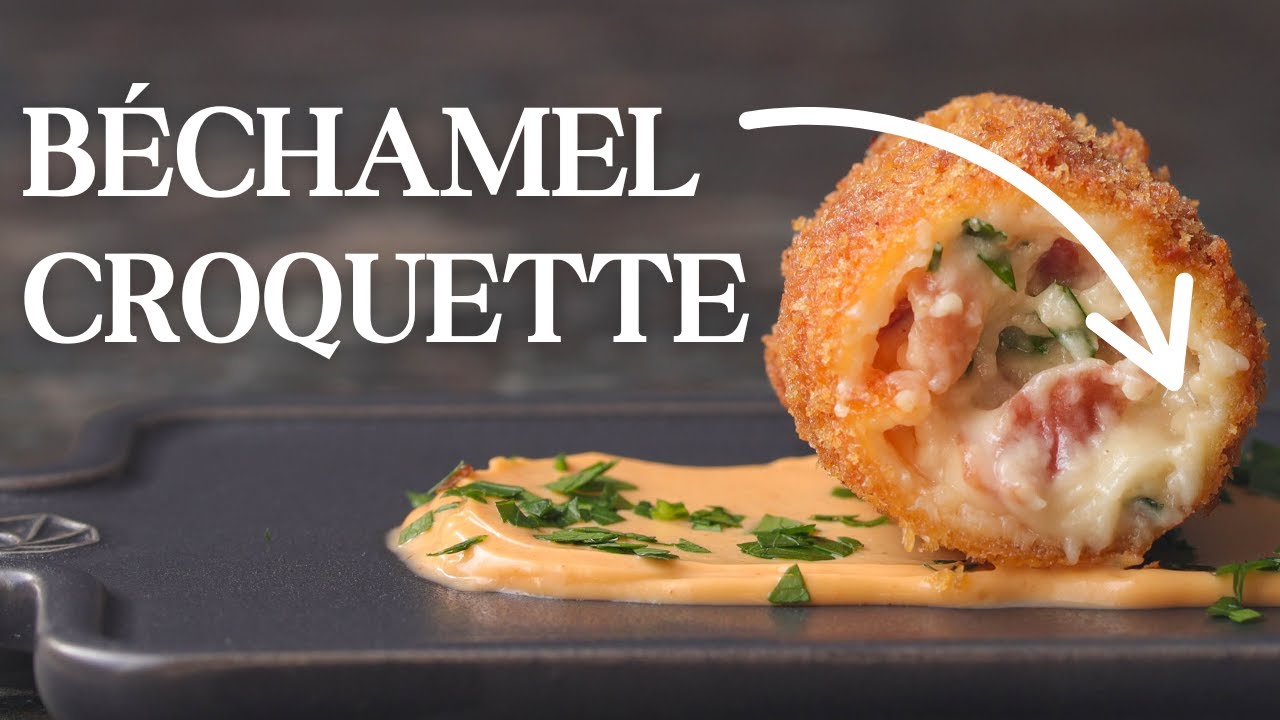
Welcome back to the channel. So this Week we're completing how Bishamel Series talking about the thick bashame. Now these versions of the vamel is used As a base when you make sule. But Because su are very convoluted and it's Been done to death, we're going to be Doing something else. We're going to be Learning how to make that fig vamel and Use it to create something that is ultra Popular at the moment. It's been Trending for some time. It's showing no Sign of stopping. And these are the Crockett. And you may know them as Crocettas in Spain. Tapas food, finger Food. I'm seeing them in every Restaurant as a starter. And they are These deep fried kind of nugget of Goodness filled with a cream mixture With ham, with cheese, mushrooms, Sometimes fish, or anything that you Want. Now, in this video, we're going to Be learning how to make the fig version Of the bishame. And I'm going to show You how simple crocketts are to make. And honestly, once you've watched that Video and you follow the steps and You've made your first crockett, you're Not going to stop and you're going to be Rocking the kitchen, creating all kinds Of delicious crockett at home, the same That you find in the restaurant, and Everybody is going to love you for it. Let's begin. All right, so let's assume
You went to a restaurant, you've seen Some crockets, and you really want to Make them at home. You've heard here at The French Cooker Academy that we can Make crockett with a fig bame. So there We go. We're going to be making a small Amount. So, we're not going to use a Little of milk, but I'm going to use Half a liter of milk. I've got my 75 Gram of flour, 75 gram of butter, and my Flavoring for my milk. I'm also going to Add one or two tablespoon of cream just To make that little bashame base a Little bit better. So, that's the base. We're going to have the fig bashame. That's the core of your crockett. The Rest is the flavoring. What do you want Your crockett to taste like? Do you want A cheese crocket? Do you want a ham Crockett? Do you want a mushroom Crockett? Or do you want a salmon Crocket? Anything is possible. So all What we're going to do here is to make That base and then you can incorporate Anywhere, you know, from a third of the Weight of your bashamel to even half the Weight with whatever you want and Whatever flavoring you want. So here Today I want to make something with Paralam and menchgo cheese. So there we Have it. I've got my Spanish mengo Cheese. I've got some paraham that's Beautiful from the delhi and I've got All the components I need for my
Bishamel. I'm good to go. I can go and Make my crockett. Now let's get started. We're going to start by making the r Which is melting the butter first and Then mixing it with the flour. Remember medium heat. We don't want to Rush things. My butter is melted. I've Sifted my flour and immediately I'm Going to add all the flour at once. And There's a lots of it because this time We need lots of r. Remember this is the Thickening agent that's going to thicken Our meal. We're going to leave it to Cook for at least for that amount 3 Minutes on low heat. 3 minutes have Passed. I've turned my heat off and We're going to now leave that r to cool Completely. So, I'm going to put this on The side of the stove and we're going to Be preparing the milk. For the milk, We've seen this before. The heat is off. I've got half a liter, bit more than two Cups of full cream Milk. And I'm going to be adding in here My flavoring. So, we know onion tastes Great in the bashame with plenty of Onion with some cloves attached to it. So, I'm going to put a bit of time. One Bay leaf is enough. And a bit of salt And pepper. A bit of salt. The ham is Salty, so not too much. And for the Pepper typically is white pepper, but Because here it's going to be enclosed In my croet. And I like the taste of
Black pepper. This is a single origin Pepper. I'm going to use that. And a Touch of nutmeg. Nutmeg is for the Purist. It is optional. I'm adding just A touch. Don't overdo it. Can be Overpowering. The flavoring has been Added. I'm mixing the whole lot. And I'm Going to turn this to a low to medium Maximum kind of heat because there's no Rush. And we want to give uh you know The uh flavoring element enough time to Actually flavor the milk, especially the Onion. So using a low heat is going to Give you time for the flavors to to Diffuse and it's going to leave time for Your root to cool down as well. So just In time, I think my milk is just about Ready and I've grated my cheese. I've Cut my ham. Remember this Palmer ham. This is a cure type of ham. It's about 100 grams, 100 g, about 200 grams. And Because I'm French, I added some parsley As well. Sorry for the parsley hater. And now back to the milk. The milk is Ready. I've just turned the heat off. And that was cooking on low heat or Warming up on low heat for quite some Times. And one thing to keep in mind is The level of evaporation. So when you Use this precise measurements, if you Want to make a soule or some other Stuff, there was half a liter about more Than two cups of milk. Let's have a look At how much is left. So I filtered the
Garnish out and I've put the milk in That container again. And now I've got 450 ml which is too little. So this Little thing to keep in mind, you don't Need to make this measurement. But one Of the advice I always give by default When you want to make sure to have Always the right amount, add an extra 50 Mm at least of uh milk when you cook. So Here it was calling for 500 mil for Instance. put 550 like this, you can counter that Evaporation like this. You sure when It's ready, you're going to have the Half a liter. So, if that happens or What you do, you take some fresh milk And you top up. So, there we go. I'm Going to take some fresh milk and I'm Going to go up a little bit more. Look, Finishing the vest. Perfect. Now, we're Done. And now for the best part. We're Going to be making the fig version of The bashame. There's a lot of r and it's Cooled down enough. And I'm using a very Sturdy whisk in here because it's going To get thick. So I'm starting with a bit Of our milk. And as always, we go around The pan. We're catching all of that R. And we dilute It before we add the rest. And remember, The heat is off at the moment. Once I've Got that base is nice and thick, the Consistency of the sauce, I can then Slowly and gradually add the rest of my
Milk. The milk is in. I'm now going to Put the heat back on to medium. And You're going to start whisking slowly But constantly. And trust me, that is Going to thicken big Time. Okay, so five plus minutes in. Look at this super thick Bashamel. There's now the consistency of A paste. And all what we want here is to Reach that boiling consistency. And so We got this little kind of volcano Appearing on Here. Oh, you see there we go. From Here, what I'm going to do, I'm going to Reduce my heat, the lowest of setting. I'm going to take my cream because cream Always adds something. There's not much, About what, 20, 30 Mil. And we're going to leave this on Very low heat to cook for another five Minutes because there's a lot of flour And we want to kill as much of that Floury taste as we can. So, we've got Our warm mixture on here. We're going to Check the seasoning of the Sauce. So, I'm taking a spoon and I'm Checking if there's enough salt and Pepper. There's a slight lack of salt, but what We're going to do here, we have to add Our cheese. And that is very salty Already. So, always take take this into Consideration. Do not add too much kind Of
Um salt in your preparation before Adding the other ingredients. The ham is Salty as well. And it's only towards the End when everything is in that you taste And if something is lacking, you add Some more. So, first you may have to Raise the heat slightly. It's going to Cool down the preparation. First Incorporate the Cheese. Okay, the rest of my cheese has Been incorporated becoming all stringy. And now time to add the ham, of Course. So, beautiful pieces of ham. If You want to add little bit, maybe half You you can. So, I'm going to go first With half. See how I go, how I feel. It's all going with the eyes and you Know the consistency and how the Ingredients like The the proportion of Ingredients. You see when I'm mixing Like this if I'm in a restaurant if I'm Biting into a crocket for instance do I Want to see like lots and lots of ham or Is this enough? It's up to you to judge You know that's how you make a good good Cooking. Don't just rely on the others. You know go with your own feelings your Own instinct. I don't think I'm going to Use all my hams. 100 g a bit too much. I Think about 60 g, something like that Would be enough. So, a bit more we'll be Done. Oops, I almost Forgot parsley.
Yes. And now we can Mix. You got to love parsley. Look at These colors. So, I think we're done Here. Look at the mixture. This is the Filling of your crockett. So crockett is That mixture and that we're going to Bread and then deep fry. But first, Before we do anything else, we're going To have to take this out. And the magic Is to leave this to cool down. This is The secret of the crockett to be able to Shape them and everything like this. You Need to take all your base mixture in Here, your fig bishame, nice and tasty. And we need to let it cool down on a Tray like this. Once you've laid down Anything on a shallow tray that is very Wide, it's going to be cooling down Quickly. You put a plastic film, but not Like that. This is the thing not to do Because you're going to have a crust Forming at the top as soon as it cools Down. What you want to do is to actually Go down and you place this in direct Contact with your bishame on here. You See? All right. So, when this is done, We're going to put this either in the Fridge. If you're patient or if you're Impatient, you can use the freezer to Accelerate the cooling. And we're going To have to wait until this is absolutely Completely cold. Now, on the bishameal Mixture here is cold and is totally Solid. This is fridge cold, but 5 to 6°
C. All we need to do now is to cut Pieces of a certain gramage to make our Portion for a crocket. So if you want Typically it's 50 to 50 to 60 g I think For a crockett. Uh but it's up to you Whatever size you like to do. But it is Ideal to take a scale and measure each Portion to make sure it's all equal. If We're going to be shaping these things Uh they all going to be the same and you Don't want to end up with a tiny one, a Large one, but especially when you're Going to be deep frying after, it pays Off to have the the same portion so it Cooks in the same time as well. So let Me show you. So here we are. I've got my Tray. I took a bit of a portion. This is About 45 g. Let's say 50 g. That's the Amount. You can see it's a generous Proportion. And from here, what you need To do uh is to like when you Make you're going to put this in a flour And you're going to shape this in Whatever, you know, whatever shape you Like. So, if you want to make like a Crocket shape, like a, you know, a kind Of a cork shape, you can. So, in your Hand, you roll it well in flour. You Make sure there's plenty of flour and You can start rolling. So, you can make A shape like that. H if you want to make A bowl, you make a bowl. Uh it's up to You. So for if you want to make a bowl Like this and then you make your shapes
And we're going to put this on the Plate. So you choose whatever shape you Like. It really it doesn't matter. So Here we are. I've used all the mixture And I've got 14 crockets and this is About 45 g. So you can easily make 15 Out of there. So once they've been Rolled up, my advice is put them in the Freezer to firm up for like 10 minutes, Something like this. And we're going to Go to the next step, which is the Breading. Once your crocket has firmed Up, it is time to do the breading. The Breading uh is very simple. I've got two Crockets here for an example. All what You need is some eggs and some Breadrumbs. We've got the flour already On the crockett. So, we're just going to Beat the eggs with a little bit of salt. The salt helps liquefy the whole egg Mix. And we're going to plunge the Crockett in the eggs and then put them In the breadcrumbs and coat them. That's It. One of the techniques that I'm using More and more is using one of those Things, a slaughtered spoon, I think It's called. It's a large spoon. It's Got these holes. So when you take your Crocket, you don't want to handle them By hand because you're going to put your Finger mark. They're going to miss their Shape. So I'm I'm kind of rolling them On here and put them in there. And then I'm
Rolling with the uh with my spoon. I'm Rolling the crocket into the egg. You Don't need to have tons of it. And then I'm taking it out. So you see it drips. And I'm not using my hand here at all. I'm putting the crocket on here. And From here then you can start the Breading. Okay. Closer look on here. And Then I'm just again you want to Avoid to try to press too much the Crocket like with you and don't kind of You know squeeze them or anything like This. I've kind of gently I use your Hand like this and roll them in. And That's about it. If you want to have More breadrumbs or anything like this, You can put it back into the egg mix and Then back into the breadrumbs. But That's going to kind of dirty your your Egg mixture. But this if you want Multiple layer, but here for me, you Know what? This is enough. I'm going to Reserve this on a plate and I'm done. So You see it's not difficult and you get a Beautiful result. And these are cured Ham and menago cheese crockets. Absolutely beautiful. And they're ready To go. Before you can deep fry these, There's one catch though. They need to Be frozen. And this going to ensure the Best possible result. So you can't just Finish them and throw them in a deep Fryer. So typically you put this on the Tray and put them in your freezer and
Once they're frozen they're really kind Of really hard then you can deep fry Them. Now, the good thing about phrasing Is that you can make plenty of those in Advance on the tray. Keep it keep them In a box in a container, an airtight Container, and keep these for your kids, For your friends, for apparative as a Safeguard, you know, when you don't know What to make. And you can pop one, two, Three, or four of those anytime you Want. Throw that in the deep fryer and You go to an amazing restaurant quality Starter. So, what I'm going to do here, I'm going to put these in the freezer And when they're ready, well, we're Going to deep fry. Once your crockett Are frozen, it is time to cook them or Deep fry them. Now, you can use other Things. I've heard people using deep Fryer. You could use the oven, but Honestly, for me, deep frying for Crockett is the best. Now, I've left Mine overnight in the freezer. I think It's the easiest option. Make them, put Them in the freezer, you wake up the Next day, it's ready to go. For the Tools, a little tray or plate with like A kitchen paper, a heat proof little Spatula or a spider is cool. You get Something more sturdy for anything deep Frying. and the food thermometers Because I am using a makeshift uh little Deep fryer. It's just a pan with some
Oil. If you have a deep fryer with the Temperature set, you don't need this. But I'm going to show you here with just A small pan how we go about it. So for The oil, if you have a deep fryer of the Temperature, you don't have to worry. If Like me, you got like just a pan with This is just a liter of oil and you're Going to put your thermometer. You're Going to wait for it to be at least at 175 180° C before you put the crockett. Cooking time depends on the size. Anywhere between four to six minutes. I Think mine might be like five minutes. Yeah, I'm 152. I'm almost there. But the One thing you need to keep in mind is That once you put the cold crocket, the Temperature is going to plummet. So you May have to briefly raise the heat and Keep on checking the temperature to you Don't want it to below 170 otherwise not Going to cook properly. But you don't Want to do it too hot because otherwise The the breadcrumbs are going to burn Too fast. And remember, like 5 minutes Is quite long. So, so let's get started. I'm going one at a time because I want To see what's going to happen in case There's any problem. Put that in. And I'm going to put my timer on. There's a Lot of crackling going on here. Don't Know if it's because it was frozen. Oh, You see sometime it can start to uh the Bashame wants to escape. So, that hasn't
Been long in. So, you see maybe my oil Here was slightly too hot. 2 and 1/2 Minutes in. It's come down now because My oil is 170 and I think that's the Right spa the right pace. 170 Celsius. Look at this coloring. It's nice and Even. Time is on. But I think it's done. It's starting to quiet down the bubbling And stuff. There's a few black bits in Here. I'm going to remove. But looks Pretty good. So, off to the next one. Okay. So, I'm going to do another try. This is barely 170°. Let's see how it goes. That's Already much more gentle. Much more Gentle. I prefer that. Once your crockett are ready, you're Going to put them on the paper towel to Drain the excess of oil. And you want to Serve them as fast as possible because They can get cold. So I've made three on There. And now it is time for the dish. I've just served one crocket with a bit Of that, you know, this kind of chipotle Mayo on. You serve it like this to Guest. One or two crocket per person. You don't need much. And it look nice. So got a crockett. This is a bit of a Chipotle kind of mayo on here. and very Soft and it's Just so it's just warming up. This is Not Boiling. There's a little spiciness Coming
From that mayonnai. I'm not sure if it's Really welcome, But that is absolutely do it. You will Gobble up these things. Okay. I think I Had one in between. I did a sneaky One. Um I just want to see really it's Another shape this one if we cut. So Let's be serious. I'm going to put this On the side. Oh, look the Cheese. Look at that. And if we Press, you get that the Bashame, that thick bishame as in there. And it's by Size and a layer of Crunch. That's so good. Well, now Honestly, what did you think? Now, these Crockets are excellent. And this is why I like the fig bashame. Everybody wants To make soule sule sule chi sule. We've Done that a million times. Start making Something different. Make crockets. You've seen it for your own eyes. The Presentation looks like a little Restaurant. The inside is creamy. It's Warm. It's tasty. And you can change the Flavoring. Nothing is set in stone. It Is up to you to choose what you prefer. When these are made there in the freezer Even more convenient that is for kids, For guests, for family, they will be There anytime you need them. 5 minutes To the deep fryer, 170° C. All right. And you'll be laughing because once you
Start eating these things, they're just So good. It's just absolutely crazy. But That completes habish. I hope you enjoy The whole series. If you want to see More of these kinds of miniseries, let Me know in the comment section. And if You want to go back to recipes, don't Forget that if you sign up to our Newsletter, that's totally free to get All the latest news. We do offer a free Recipe ebook that you can download Immediately after you sign up. It will Be sent to you. It's been formatted here By Kate and there's plenty of easy Recipe to make at home. Well, that Completes the video. I will see you, of Course, next time on the French Cooking Academy with something new. Take care. Bye-bye. Whip Up. Don't leave Me. I don't want to jinx it, baby. You were thinking

Have you ever wondered why most of the Vinaigrettes in the grocery store are made with 10, 20, sometimes even almost 30 ingredients? I remember growing up in Provence watching my mother whipping vinaigrettes before every single dinner. She would mix in a giant bowl, delicious extra virgin olive oil, a robust aged vinegar (the flavor would depend on the main dish), sea salt and pepper and voila! I decided to do the same thing for my family and friends more than 20 years ago here in this beautiful country. And Provence Kitchen® was born. Stay tune for more articles and wonderful family recipes..

Leave a Reply