

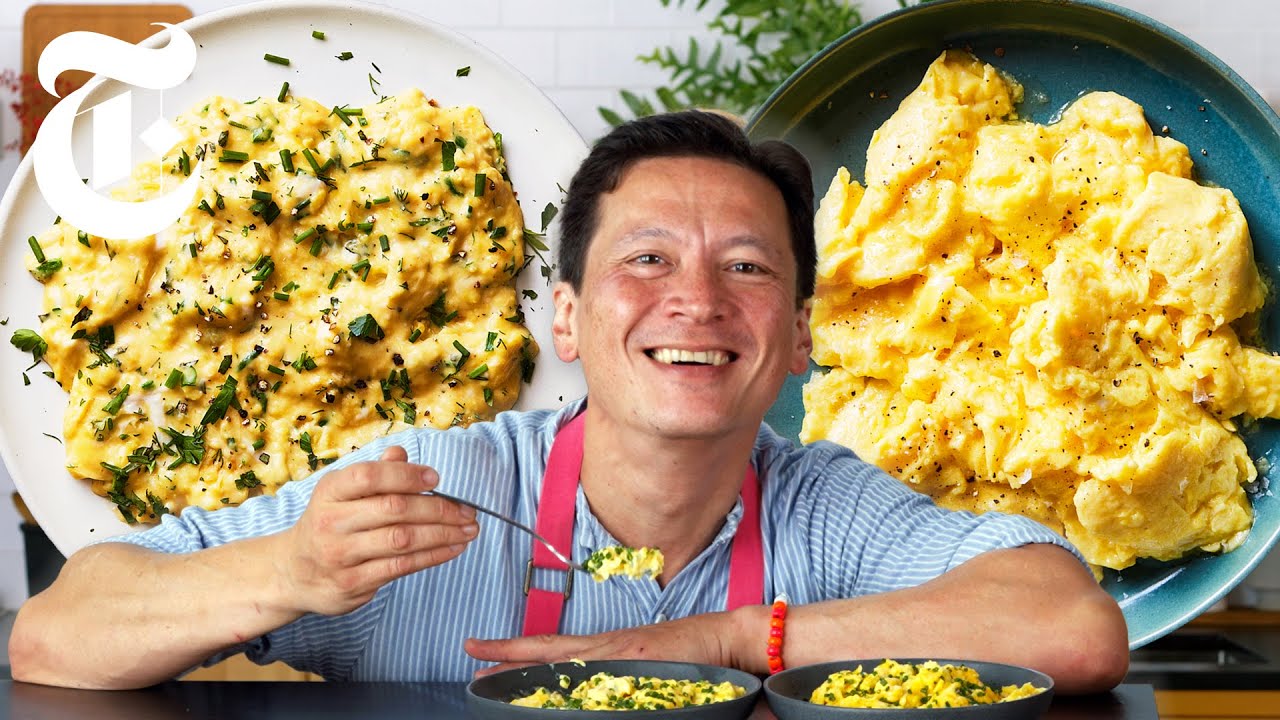
“Mm. Mm, these are gonna
be real, real creamy. Mm. Mm. Sorry. How do I wrap this up? Hey, everyone, I’m
Kenji Lopez-Alt. I am a ‘New York Times’
columnist and a cookbook Author. I’m going to be making
some scrambled eggs today.” [JAZZ MUSIC] “So I’m going to first show
you a couple of real basic Ways to make scrambled eggs,
and then I’m going to show you A couple of unique ways that
will give you these eggs that Have a different texture from
your normal scrambled eggs. We’re going to start
with the most basic kind. I’m going to do a
couple eggs here. Let’s say three eggs. I’m going to salt
my eggs in advance. You might have heard people
tell you never to salt Your eggs until they’re done. They might have told you
that the eggs will come out Tough or gray or watery. I’ve tested this
pretty extensively. In fact, what happens when you
salt your eggs beforehand is They will come out more
tender and more moist. The salt actually dissolves
some of the egg proteins, So that as they’re cooking,
they don’t tighten up as much, And so they don’t squeeze
out as much moisture. What you find is that if
you don’t salt your eggs In advance and you cook ‘em,
they can sort of start to weep Out water as they sit,
whereas if you salt your eggs In advance, they
retain that moisture. If you can do this up to about
15 minutes before you start
Cooking them — you
get up in the morning, You salt your eggs, you
go wake up the kids, Brush your teeth, do
whatever you have to do, And then come back
and scramble them, The texture will
be even better. So our pan — We’re doing a
nonstick skillet here. I’ve never actually used one
of these ceramic pans before. One of the things that can
really affect the finished Texture of your eggs is
the starting temperature Of your pan when
the eggs go in. So if your pan is cold when
the eggs go in, you end up With these really dense,
creamy, almost custardy Scrambled eggs, whereas
if your pan is hot, What happens is as soon
as your egg goes in, The moisture in there
starts to evaporate, It bubbles rapidly, and so
you end up with these lighter, Fluffier scrambled eggs. The difficulty, though, is
that it’s really hard to tell What the temperature of the
pan is when there’s no food In it. So what I do is I add a
little bit of water like this, And as the pan
is heating it up, I just swirl that
water around. By doing that, I’m
guaranteeing that the surface Temperature of the pan is
not going to rise above The boiling point of water,
above 100 degrees Celsius. And luckily, that temperature,
around a little bit Above 100 degrees Celsius,
is the exact temperature That I want for my eggs. That’s the temperature where
you’re going to get a medium Fluffiness, so not super
dense and creamy, not really, Really light and
fluffy, but what I like, Which is sort of tender curds
that are fluffy but still
Very, very moist. As soon as that water
evaporates or there’s barely Any water left, that’s when
we know the pan is at a good Temperature. I’m going to add in about
a tablespoon of butter, Give that a little swirl,
just to coat the bottom. I’m going to go
in with my eggs. If you want your
eggs fluffier, You can let them sit a bit
and just stir really gently. If you want them creamier, you
can stir them more vigorously. And that’s really how you’re
going to change the final Texture of the eggs. Now, the important thing to
remember when you’re cooking Scrambled eggs is that
whatever it is in the pan, It’s going to be a little
bit drier on the plate. So you actually want to take
them out of the pan before They look like they’re done. See, right now, these
eggs look kind of perfect. I’m going to let this sit
for an extra 30 seconds, And then we’ll see what
happens, all right?” [MUSIC PLAYING] “How long has it been? 15 seconds?” “18 seconds.” “All right. It’s only been 18 seconds,
and let’s see what’s happened Here. So even with 18
seconds sitting there, You can see these eggs have
already completely dried out, Or almost completely
dried out — Not really the texture I want. What I find to be a little bit
difficult about scrambled eggs Is that if you get
distracted at all, They’re going to
completely change texture.
The two recipes I’m
going to show you now, Kind of, attempt to
solve that problem, And also build in some
textures that you wouldn’t Find just from regular eggs.” [MUSIC PLAYING] “So the first recipe I’m going
to show you is my extra creamy Scrambled eggs. This is probably the strangest
scrambled egg recipe you’re Ever going to see. It starts with cornstarch,
which seems a little bit Strange, but it’s actually
a relatively common addition To egg dishes in China. So dishes like scrambled
eggs with tomatoes Often has a little bit of
a cornstarch slurry to it. Whampoa-styled scrambled eggs,
which are sort of these eggs That you cook in a
wok that come out Of this sort of creamy
golden wave of eggs, They often have a cornstarch
slurry added to them. The slurry is going to
help the eggs remain tender And also get a creamier
texture to them And retain moisture
a little bit more. So we got a little bit of
a cornstarch slurry there. I’ve got cold butter that’s
been cut into little cubes. This is a technique that
I learned from my friend, Francis Lam, who — I think he learned it
from Daniel Boulud, who Makes his omelets this way. So you add little cold cubes
of butter to the omelets, And as the butter
melts into the eggs, It keeps them tender.” [MUSIC PLAYING] “Four eggs, pinch of salt — Beat these all up together. And meanwhile, I’m going to
do the same thing with my pan.
I’m going to get a little
bit of water in there just To gauge the temperature.” [MUSIC PLAYING] “Shake the pan just to
make sure that it’s an even Temperature. A medium-high heat here — if
you’re scared about how fast Your eggs cook, you can reduce
it down to medium, no problem. So we’re going to put the
rest of that butter in there, Little cubes of butter. By the way, these are,
like, weekend eggs, So about a tablespoon
of butter per egg, Which is a lot. You can absolutely get away
with using 1/4 of that amount Of butter, an 1/8 of
that amount of butter. Use as much or as little
butter as you want. But I’m making these real
extra creamy, extra rich — What I call weekend eggs. So we’re going to
get them in there. We’re just going
to give it a stir. Because we add that
cornstarch slurry in there, The proteins just
don’t bind as tightly. So what that means is that
for any given doneness — So you like your eggs really
firm or really soft — They’re going to
be extra moist. So if you make them
exactly the same As you normally would,
they will come out Just that much moister. And the other good thing
is that they don’t overcook As easily. So you can leave these in
the pan an extra 15, 18, 30 seconds, and they’re
going to be just fine. They’re still going to be
plenty moist because of that Cornstarch slurry
— and obviously, All the extra butter as well.
This is just about
where I like them — So really, really moist and
creamy, nice soft curds. I like to finish my eggs
off with some chives, A little crack
of black pepper. All right, so those
are the extra creamy Scrambled eggs with a bit
of a cornstarch slurry And a bit of butter. So our final scrambled
egg recipe — This is what I call my
velvety scrambled eggs. I’ve been playing around for a
little bit with cooking things In heavy cream
instead of butter. Lisa Steele, who wrote a book
called ‘Fresh Eggs Daily’– She has a wonderful recipe
for cream fried eggs, Where you put cream
in a saucepan, You break your eggs
into it, and you cook it Until the cream caramelizes. I thought, what would happen
if you cook scrambled eggs In cream? So that’s what
we’re going to do. I’m going to start with three
tablespoons of heavy cream In a pan here. Meanwhile, I’m going to,
once again, salt my eggs. This time, I’m just going to
add some of the chives right In there, just for funsies. Just for funsies —
no, just for fun. [CHUCKLES]: Let’s add some
black pepper in there as well. So we’re going to
beat this really well. Now, with these
ones, I really want There to be no bits
of streaky egg whites. I really want it to
be nice and smooth. So you’re going to see —
we’re going to drizzle this Into the cream, and that’s
how we’re cooking it. All right? So once our cream is
at a simmer like this,
I’m going to take my
eggs and kind of just — The way I would do almost,
like, egg drop soup, I just Take my chopsticks
or a fork or whatever And just kind of
drizzle them in. And what you’re going to end
up with is eggs that have An almost ribbony
quality to them, Sort of a unique texture. We’re going to really
gently swirl these around. And as they’re just
about to finish, I’m going to take that last
tablespoon of heavy cream And dump it in
and just stir it. And that’s just going to
give them that extra level Of velvety moistness. So these are going
to be, by far, The creamiest,
most velvety eggs. These are the kind that
you might very carefully Pile onto toast and eat
with a napkin on your lap. Finish it off
with some chives. A little bit more
black pepper. And there you go. These are one way to
overcook scrambled eggs — [LAUGHS]: and two
different ways To make them really
nice and creamy. So this is the extra
creamy scrambled eggs, Which has a bit of a
cornstarch slurry in there And little cubes of butter. This is what I call
my weekend eggs. And these are your
velvety scrambled eggs. So these are the ones where
they’re cooked in heavy cream. There’s a little bit of heavy
cream added at the very end. So they’re very, very
creamy, very, very loose, Something that you
would put onto a nice — I like to put them on top
of shokupan, Japanese toast. And I do that in place
of butter on the toast,
And it’s really, really great. All right. So three different
kinds of eggs — I’m going to try all three
of them. (CHUCKLING) My cold, Overcooked scrambled eggs — I’m sure they’re actually
going to be still fine. Yeah, they’re still real
good — a little bit dry, A little bit leathery. All right, let’s try
the extra creamy kind. I cooked them until what
would be the equivalent Of a medium scramble for me. Mm, they’re much softer
and more tender and moister And creamier, and all those
other words that make you Uncomfortable. And finally, these
are the velvety ones. So these are going to
be real, real creamy. Oh, look at that. Mm-hmm. I used heavy cream here. If you want a little
bit more flavor, A little bit of that tang,
you can actually use creme Fraiche, exactly the same
way you use heavy cream, And it’ll give it a
little bit of that tang.” [MUSIC PLAYING] “It’s real good with
heavy cream, though. You can find the recipe for
extra creamy scrambled eggs And for velvety
scrambled eggs, As well as my other recipes
and many other amazing recipes On nytcooking.com.” [MUSIC PLAYING]
Have you ever wondered why most of the Vinaigrettes in the grocery store are made with 10, 20, sometimes even almost 30 ingredients? I remember growing up in Provence watching my mother whipping vinaigrettes before every single dinner. She would mix in a giant bowl, delicious extra virgin olive oil, a robust aged vinegar (the flavor would depend on the main dish), sea salt and pepper and voila! I decided to do the same thing for my family and friends more than 20 years ago here in this beautiful country. And Provence Kitchen® was born. Stay tune for more articles and wonderful family recipes..

Leave a Reply