

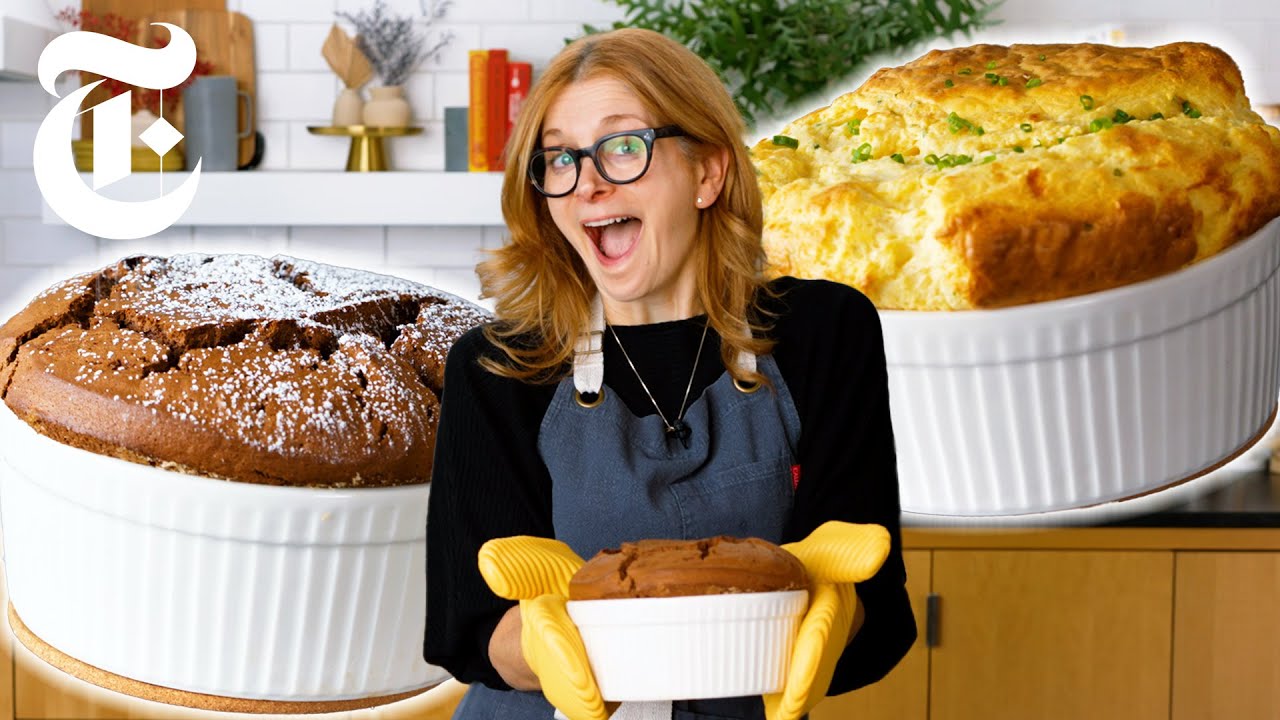
“Don’t drop the souffle. Don’t drop the souffle. Don’t drop the souffle. O.K., good. Oh.” [MUSIC PLAYING] “Hi, I’m Melissa Clark. I’m a reporter
for NYT Cooking, And we are here in the
beautiful kitchen studio To make souffles because
we want to treat ourselves To something delicious. Today, we’re going
to make two souffles, A sweet one and a savory one. We’re going to make a
cheese souffle with chives. The sweet one is
going to be chocolate. It is a French dish that came
about in the 18th Century. It didn’t get codified and
written down in the form that We know it today until
the early 19th Century. And what happens in a perfect
souffle is that all of that Air that you’ve beaten
into the egg whites expands In the oven and
pushes the mixture up, And it rises and browns
and becomes so light And so ethereal
and so delicious. And why aren’t we
making one already? You want to take all the
racks out of your oven, And you put a baking sheet
in your oven upside down. You’re going to put your
souffle dish right on top Of the sheet pan, which is
going to get hot when we heat Up the oven. And you want to set it to 400. First, we’re going to
start with our savory one. The classic souffle
dish was developed Because you have a
very thick porcelain Dish which slowly heats up,
which helps the eggs to rise.
You want to prepare your dish
really well because if you Don’t butter it, the
souffle will stick. Then you’re going to apply
some kind of dry ingredient To the sides to help
the egg whites climb. To the cheese souffle, we’re
going to use grated cheese On the butter. If you didn’t use
the grated cheese, You would have this
slippery butter, And it would just be harder
for the egg whites to rise. Basically, we’re
making a white sauce, So we’re going to
just heat the milk up. I’m going to cook the flour
in the butter and then add The warm milk. So the reason that you cook
the flour in the butter Is to get rid of
that floury taste. It improves its
thickening power. It helps it thicken. You just want it to be
a little bit golden. So you want to
stir, stir, stir, Because you want to get
rid of all those lumps. You see how tight
this is and how thick? This is important because if
the mixture were too runny, It would drag the eggs down. So you’re looking for actually
quite a tight mixture. It should look like paste. Now, I’m going to add the egg
yolks to this white sauce. But I don’t want to do it
until it cools down a little Bit. I want it to be warm, but
not hot enough to cook them. I’m going to add my seasoning
first, paprika, salt. This is freshly grated nutmeg,
and then I’m going to add The yolks. But I’m going to wait for it
to cool down just a smidge. You know what’s annoying about
most classic souffle recipes,
Including this one? It calls for five egg
whites and four egg yolks. Luckily, having an extra
yolk around is a good thing. I love it on rice. Oh, my gosh, just like an egg
yolk into a bowl of hot rice Is the most delicious thing. So we know, right now,
eggs are really expensive, So this is a bit
of an investment. But souffles are also
a time investment. They’re an energy investment. So you’re not going to make
a soufflé on a casual Tuesday Night. They’re a luxurious dish. This is when you want
to treat yourself. So we’re going to
let this hang out, And we’re going to move
on to beating the whites. So traditionally, when
souffles were first Coming into being, there
were no electric mixers. It was all arm power. But people used copper
bowls, and the reason They would use
a copper bowl is Because a little
bit of acidity Helps the egg whites reach
volume, and then keep Their volume without
becoming over beaten. We’re going to use an electric
mixer and a regular metal Bowl. To make up for that acidity,
I have cream of tartar, So that is going to help
the egg whites reach volume And also prevent them
from over whipping. When beating egg
whites, you want To start at a medium
speed and then Gradually build the speed. So we’re getting foam. We’re just going to wait for
them to reach stiff peaks,
And I’ll show you
what that means. What do they look like? They look like a bubble bath. They’re in bubble bath stage. Eventually they’re going
to become cloud-like. Basically, this is
what we’re looking for. When you pick your
beater up, they Need to hold little peaks. See, that’s not going away. That’s just staying there. I’m switching from this to
this because what I want to do Now is I’m going to fold these
whites into this mixture, Which is still warm,
which is what you want. It’s much harder to
incorporate the eggs Into a cold mixture like this,
because you see how thick it is. If you put it in the fridge,
it would get even thicker, And be really hard
to fold the eggs in. You really can’t
make this ahead. This needs to be warm. So you want to add the egg
whites about a quarter of it At a time, and I’m going
to work quickly but gently. Folding is an exercise
in slowing down for me Because you don’t
want to over mix. What you want is to
keep as much volume As possible on these whites,
and not worrying about these Streaks. I’m leaving them there. That is perfectly fine, and
especially at this stage, Because there’s going
to be more mixing. And folding really is — I’m just folding the
mixture over onto itself. And now that I’ve
gotten it lighter, I’m going to start adding
the cheese as well. So it’s just all
goes in stages.
Gruyere is traditional
for souffles. You can use any kind of
semi-firm grated cheese, Conte, cheddar, gouda. And then this is
just parmesan, And we’ve got some chives,
but any herbs would do. So I am going to keep
folding until almost All of the white streaks
are gone, but not all. I’m going to purposely leave
some white streaks in there. Yeah, I think this is
ready to go into our dish. Look at that. Does this look as
awkward as it feels? I’m holding this backwards
just so you all can see. All right. So now I’m going to show you
another trick to help us get The best possible
rise on the souffle. When it reaches the
top, it could get stuck To the cheese right above it. If you create a little
bit of separation, What you’re doing is you’re
giving it space to just keep Rising. You want to take
either finger or thumb, And I’m going to create a
little space between the edge Of the souffle on the
top and the souffle dish. And this is going to help
the souffle rise right up. And that’s it. So now, this is going to go
into our preheated oven.” [MUSIC PLAYING] “Alrighty, here she
is, a thing of beauty. And it should be
jiggly, but firm. You see how that
is jiggly but firm? Oh, she’s a beauty. Everything happened the way
it was supposed to happen. The air trapped in the
egg whites got hot. It expanded.
It pushed it all up. It rose. It’s gorgeous. We’re going to put some chives
on top just to make it even More gorgeous. Seriously, is there anything
more special than a souffle? Serve these hot. This is going to — you
can see, in real time, Can you watch it deflate? I want to get a side piece
because I want to show you, That’s what you get from
buttering and cheesing The souffle dish. I mean, souffles are
just really, really good. They’re not fast,
and they’re not easy. But, boy, are they worth it. All right, that’s
it for this guy. Now that we have
mastered the savory one, We’re going to go
on to the sweet, And we’re going to
start with the dish. Let’s see how high
rise we can get. And now sugar. Be generous. See how I’m working
over this pan? So that way, I can pour
out the excess sugar. You really want a
nice, thick coating. So that is done. This will just be waiting for
us when we’re ready for it. All I’m doing is melting
chocolate with butter, And I’m doing it in a
double boiler situation. So water on the bottom. Bowl goes on top. I’ve got extra bitter
chocolate here. You can use any
dark chocolate. You could use semi-sweet,
bittersweet, extra bitter.
If you ever buy
bittersweet chocolate, There’s often a
number on the package. They’ll say like 72 or 55. This one is 60. That is the percentage
of cacao solids. The higher that
percentage, the less Room there is for
things like sugar. Means the chocolate will be
less sweet, more chocolaty. So this is hot. This is hot. This is done. I’m going to let this cool
down a little bit before I add My egg yolks, because I
don’t want to cook them. I’m just whisking it for a few
seconds just to cool it down. This is just a
pinch of sea salt. The eggs come out
even on this one. I’m using six whites
and six yolks, So everything gets used, so
you don’t have your little Extra yolk for
your bowl of rice. But you do have a
nice, even souffle. And you just want to whisk the
yolks in until they disappear. That is ready for folding, so
I’m just going to leave that There and bring
over the mixer. We’re going to do exactly
what we did before, Except we’re going
to add sugar. So this is crucial, so
it’s going to be slightly Different. We’re making a meringue
actually as opposed to just Beating egg whites.” [MUSIC PLAYING] “You don’t want to add the
sugar until this is already Starting to become like a
foam that would hold very soft Peaks. See, that is a soft peak.
It’s peaking, but it’s wobbly. And now we’re going to
add the sugar gradually. Notice how shiny it is? That shine is from the sugar. Ta-da. That is a stiff peak. And this is still warm,
which is what you want. And so we’re going to do
exactly what we did last time. Just fold in a
little bit at a time. And we’re going to do about
a quarter of the whites To lighten it, and then
we’re going to add the rest Gradually. It’s barely fits in this Bowl. We have so much volume.” “I’m kind of wishing that we
had lined the souffle pan with Ground up Graham crackers.” “Oh, man. Right? Graham — oh, my god, Adam,
that needs to stay in the Edit Because Adam is a genius. Coconut, Nilla Wafers would be
good with a banana souffle.” “Freeze-dried fruit.” “Freeze-dried fruit. Phoebe, genius.” “Pretzel. Pretzels.” “Oh. Can you imagine a caramel — A salted caramel
soufflé with pretzels? What else we got? I love this. O.K., friends, if
you have any ideas, Put them in the comments. A few streaks are fine,
but don’t stress it.
If you see a few streaks like
that, it’s not a big deal. And we’re going to do the
same thing that we did before. We’re just going to create
a little ledge between The souffle and the
dish for extra rise. Do I have chocolate
on my face?” “No.” “Miraculously. And then we’re going to put
this in our preheated oven, Which is preheated to 400. And then as soon as we put it
in, we lower the heat to 375. It’s O.K. if we make
a mess on our counter. It’s so pretty. I mean, it’s just so pretty. I don’t even want
to cut into it. Except that that’s a lie,
because I’m dying to eat this up. We also have some whipped
cream, which is optional-ish. Chocolate sauce would
be good with this, too, Just to paint the lily. Can you see the
texture on that? Jiggly. Just set. A little whipped
cream because why not. There’s nothing like a
classic chocolate souffle. It’s just delicious. It’s so light in texture,
but the flavor is so rich. And then with the whipped
cream, this is delicious. Souffles take work,
but they are just The best way to show
someone that you care And eat something
delicious at the same time. You can find these souffle
recipes at nytcooking.com. Come find us. You want some? Who wants souffle?” [MUSIC PLAYING]

Have you ever wondered why most of the Vinaigrettes in the grocery store are made with 10, 20, sometimes even almost 30 ingredients? I remember growing up in Provence watching my mother whipping vinaigrettes before every single dinner. She would mix in a giant bowl, delicious extra virgin olive oil, a robust aged vinegar (the flavor would depend on the main dish), sea salt and pepper and voila! I decided to do the same thing for my family and friends more than 20 years ago here in this beautiful country. And Provence Kitchen® was born. Stay tune for more articles and wonderful family recipes..

Leave a Reply